
Air Cooled Heat Exchanger (ACHE)
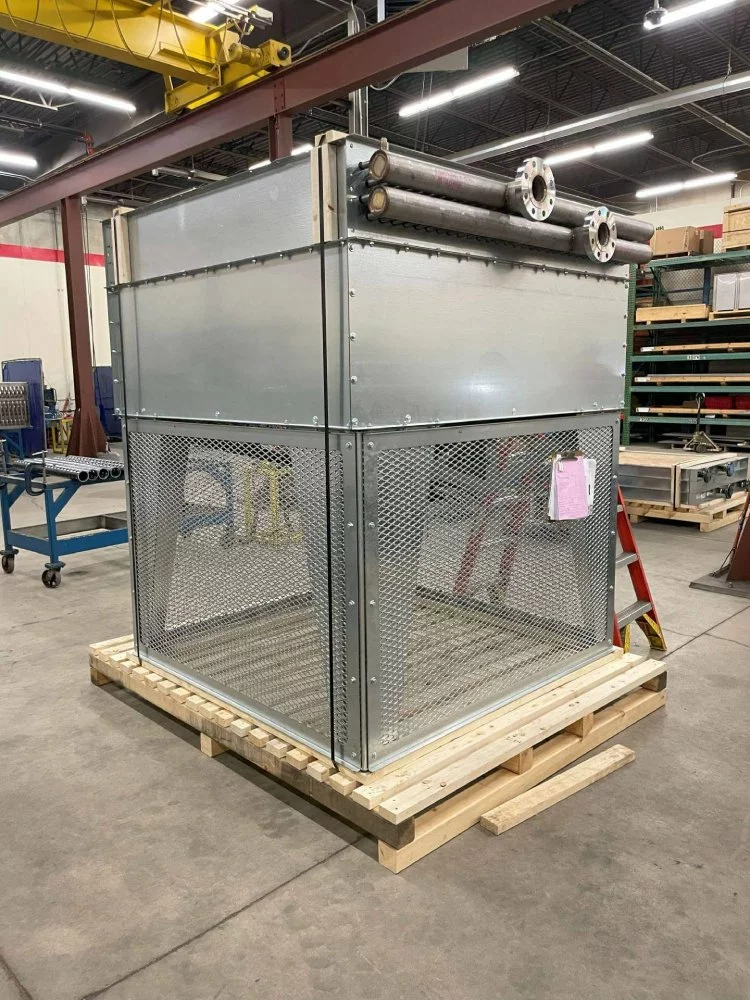
An air cooled heat exchanger, also referred to as an air-cooled fluid cooler or air-cooled condenser, removes heat from a process fluid by transferring it directly to ambient air rather than to a water circuit. At Advanced Coil Technology, we design and manufacture ACHEs across a full range of sizes and configurations for industrial customers throughout North America who need a dependable, water-free cooling solution backed by rigorous engineering standards.


How an Air Cooled Heat Exchanger Works
The operating principle is straightforward: a hot process fluid flows through a bundle of finned tubes while fans move ambient air across the exterior surface of those tubes. The fins increase the contact area between the tube wall and the airstream, thereby increasing the rate at which heat transfers from the fluid to the surrounding air through convection. The result is a cooled fluid that returns to the process ready for reuse, with no water consumed and no cooling tower required.
What varies between units is how airflow is managed. The three primary configurations are forced draft, induced draft, and natural draft, and each produces different performance characteristics depending on the installation environment and process requirements.
Forced Draft ACHEs
In a forced draft arrangement, fans are positioned below the tube bundle and push ambient air upward through the finned tubes. This design places the fan and drive assembly in the cooler ambient air below the bundle, which can extend the service life of mechanical components. Forced draft units typically produce more uniform airflow across the bundle face.
Induced Draft ACHEs
Induced draft configurations mount fans above the tube bundle, pulling air upward through the fins. This arrangement limits the recirculation of hot discharge air back into the inlet, which is particularly useful in installations where ambient temperatures run high or where the unit is located in an enclosed or partially enclosed structure. Induced draft units also tend to offer better protection of the tube bundle from the weather.
Natural Draft ACHEs
For specific low-heat-load situations or locations where power access is limited, natural draft operation uses the buoyancy of heated air to create airflow without any fan. We design natural draft ACHEs for appropriate process conditions; the trade-off is that performance is more dependent on ambient conditions than in mechanically assisted configurations.
Materials We Use in ACHE Construction
We build air-cooled heat exchangers primarily from aluminum, carbon steel, and corrosion-resistant stainless steel, and the selection of each material is driven by the operating environment and the chemical properties of the process fluid being cooled.
- Aluminum: Fins, fan blades
- Carbon Steel: Frames, structural supports
- Corrosion-Resistant Stainless Steel: Tubes, headers, manifolds, frames, structural supports
For installations in coastal environments, chemical processing facilities, or other areas with elevated corrosion risk, we also apply specialty coatings to the finished unit. These coatings provide an additional protective barrier and extend service intervals in harsh conditions.
Our air-cooled condensers range in size from 18 inches by 18 inches up to multiple-bay units measuring 12 feet wide by 30 feet long. Our hydrocarbon and steam condenser coolers are rated for operating temperatures up to 800 degrees Fahrenheit.
Benefits of Air-Cooled Fluid Coolers
Air-cooled fluid coolers provide a reliable, cost-effective, and low-maintenance solution for heat removal in industrial and commercial systems. Key advantages include:
- No Water Required: Eliminates the need for a water supply, treatment systems, filtration, and cooling tower maintenance—reducing operating costs.
- Energy Efficient: No pumping energy is needed for water circulation, and modern fan and coil designs further increase overall efficiency.
- Simple Installation: Requires no complex plumbing or water infrastructure, making setup faster, easier, and more flexible in tight or outdoor spaces.
- Low Maintenance: With no strainers, filters, or water-handling components, maintenance demands and downtime are significantly reduced.
- Water Conservation: Uses no water and avoids losses from evaporation or leaks—ideal for regions facing water scarcity.
- Consistent Performance: Unaffected by water quality or temperature variations that can hamper water-cooled systems.
- Higher Reliability: Eliminates risks associated with water—such as scaling, corrosion, biological growth, and leaks—for more stable long-term operation.
- Compact Footprint: Requires less space than water-cooled systems since there are no cooling towers, pumps, or associated infrastructure.
Overall, air-cooled fluid coolers offer a dependable, energy-efficient, and environmentally friendly cooling solution across a wide range of industrial and HVAC applications.
Applications for Air-Cooled Fluid Coolers
Industrial air-cooled heat exchangers appear across a broad range of sectors wherever process cooling is required, and a water supply is impractical, unavailable, or undesirable. Below are the primary markets we serve, along with what each industry is typically cooling.
Oil, Gas, and Petrochemical Processing
Oil and gas operations are among the most demanding environments for ACHEs. Compressors, turbines, and production equipment generate substantial heat loads, and cooling the process fluids, lubricants, hydraulic oil, and hydrocarbon streams that pass through those systems is a continuous requirement. Our units designed for oil and gas service are built to API-661 and NACE standards, which are the recognized benchmarks for air-cooled heat exchanger design in this sector. Customers in the Permian Basin, the Gulf Coast, and other hydrocarbon-producing regions use our units in both upstream production and downstream refining environments.
Power Generation and Renewable Energy
Power plants use air-cooled heat exchangers to manage condenser water temperatures in steam-cycle generation. Facilities in water-scarce regions are increasingly specifying air-cooled condensers in place of wet cooling towers to reduce water consumption and eliminate the chemical treatment costs associated with water-cooled systems. We also support renewable installations, including solar thermal and geothermal facilities, where coolant temperature management is part of the energy conversion process.
Manufacturing, Mining, and Heavy Industry
General manufacturing and metalworking operations use ACHEs to cool hydraulic circuits, quenching fluids, compressor intercoolers, and process water loops. Mining equipment, including large mobile machinery and fixed processing equipment, relies on air cooled heat exchangers to manage engine coolant, hydraulic circuits, and transmission fluid in locations where a water supply is absent or impractical. The compact footprint of an air-cooled unit is a practical advantage for remote and off-road deployments.
Design Standards and Certifications
We design every air-cooled heat exchanger to recognized industry standards rather than to proprietary specifications. That approach matters because it gives buyers and their engineers a verifiable baseline for performance, materials, and inspection procedures, and it simplifies integration with third-party equipment and systems.
Our ACHE designs comply with:
- ASME Boiler and Pressure Vessel Code (BPVC), which sets the standards for pressure-containing components including headers and manifolds.
- API-661, the petroleum and natural gas industries standard for air-cooled heat exchangers, which covers thermal and mechanical design, materials selection, fabrication, testing, and nameplate requirements.
- NACE International standards for corrosion control, which govern material specifications and surface treatment for units deployed in aggressive service environments.
- Canadian Registration Number (CRN) Code, which is required for pressure-containing equipment placed in service in Canadian provinces and territories. We support customers shipping units to Canadian facilities without requiring them to source a separate local supplier.
Frequently Asked Questions
Fin fan cooler and air cooled heat exchanger refer to the same type of equipment. "Fin fan" is a field term commonly used in oil and gas and petrochemical environments to describe mechanically driven air-cooled units. The name comes from the finned tubes and the fan that drives airflow across them. When customers ask for a fin fan cooler, we quote it as an ACHE under the API-661 standard.
API-661 is the petroleum and natural gas industries standard that governs the design, materials, fabrication, inspection, testing, and preparation for shipment of air-cooled heat exchangers. Specifying an ACHE to API-661 ensures that the unit meets defined requirements for thermal performance, mechanical integrity, and documentation rather than leaving those parameters to a manufacturer's internal practices. For downstream, midstream, and upstream oil and gas customers, purchasing to API-661 is typically a project requirement and not optional.
Yes, but cold-climate operation requires specific design attention. In freezing conditions, an air-cooled unit can overcool the process fluid or experience tube freezing if the unit runs at full fan speed without controls. We address this through variable-frequency drives on the fan motors, louvers or shutters that modulate airflow, and bundle geometry that accommodates winter turndown. For installations in Canada and the northern United States, we account for cold-climate operation as part of the standard design review.
Lead time depends on unit complexity, size, and current production scheduling. Standard units with common materials typically ship in a shorter timeframe than large multi-bay units or those requiring specialty alloys or NACE-compliant material certifications. Contact us early in your project timeline so we can give you an accurate production schedule and avoid compressing your construction schedule unnecessarily.
Fan noise is the primary source of ACHE sound output. We manage noise at the design stage by selecting appropriate fan tip speeds, blade geometry, and blade count. When projects have defined noise limits, we calculate expected sound pressure levels during the design phase and select equipment accordingly. Variable-frequency drives also reduce fan speed and noise during off-peak operation, which is useful for facilities adjacent to occupied buildings or in jurisdictions with environmental noise ordinances.
To generate an accurate proposal, we need: the process fluid type (or fluid properties for non-standard fluids), the mass or volumetric flow rate, the inlet and outlet temperatures, the design pressure, and the site ambient temperature at both summer design conditions and the annual minimum for cold-climate design. Providing your preferred draft type, available plot footprint, and any applicable standards (API-661, NACE, CRN) allows us to scope the unit fully in the first round of review.
ACHEs have fewer maintenance-intensive components than water-cooled systems because there are no cooling tower fills, water treatment systems, or biological contamination risks to manage. Routine maintenance focuses on cleaning the fin surfaces to remove airborne particulates that reduce thermal performance, inspecting fan blade pitch and belt tension or drive alignment depending on the configuration, and verifying that louvers or shutters operate correctly if installed. We can provide a recommended maintenance interval schedule with each unit delivery based on the anticipated service environment.

Durable. Reliable. Proven.
Our 5-Year warranty demonstrates our products are engineered to perform and built to last. Since 1995 we have stood behind our work. Durable. Reliable. Proven. Ultimately, this is about your peace of mind.
Have Questions?
Give us a call or fill out the form and one of our team members will be in touch as soon as possible.
507-451-0130


